

Local SEO: A Blueprint for Small Businesses to Attract Nearby Customers
January 29, 2024
In the thriving digital landscape, the significance of engaging professional
search engine optimization (SEO) services
cannot be overstated. For small businesses, particularly those in Tampa, local SEO can be a game-changer. With the right strategy, businesses can effectively tap into the local market. Tampa-based businesses, this is your opportunity to harness the power of
professional search engine optimization SEO services
, and here's your blueprint to get started
Introduction To Local SEO and Its Importance for Small Businesses
Local SEO is a strategic process that focuses on emphasizing the optimization efforts of local brick-and-mortar businesses. Its prime objective is to boost local search visibility and drive foot traffic to physical stores. The importance of local SEO for small businesses lies in several key factors:
- Hyper-targeted geographical focus : Local SEO aims at targeting potential customers in a specific area. This makes it highly efficient for small businesses that operate within a certain geographical boundary.
- Increased visibility : Local SEO helps businesses increase their online visibility and attract more customers from relevant local searches.
- Credibility and trust : With the help of positive reviews and high-ranking local listings, local SEO can enhance a businesses' credibility and foster trust among potential customers.
- Increased website traffic : Local SEO can drive a significant amount of traffic to your website, leading to higher lead generation and conversion rates.
- Competitive advantage : Small businesses can gain a competitive edge over bigger corporations by optimizing for local search, as many large companies often overlook local SEO.
Understanding Your Target Audience and Their Search Behavior
Understanding your target audience and their search behavior forms the backbone of an effective
local SEO strategy
. For small businesses, this means having a clear idea of who your local customers are, where they are located, and how they search for your products or services.
By understanding your target audience and their search behavior, you can create a local SEO strategy that reaches the right people in the right places, at the right time. Remember, SEO is not just about getting more visitors to your website; it's about attracting the right kind of visitors who are likely to become your customers.
- Demographics : Identify the age, gender, income, education, and other demographics of your local customer base. This information can help you tailor your local SEO strategies to match their needs and preferences.
- Psychographics : Understand the lifestyles, interests, attitudes, and values of your potential customers. This can provide valuable insights that can help you position your business and its offerings in a way that resonates with them.
- Geographic location : Determine the specific areas where your potential customers live. The more narrowly you can define your service area, the more effective your local SEO strategy will be.
- Search behavior : Examine what keywords your potential customers use when they search for your products or services. Use this information to optimize your website content, meta tags, and other SEO elements.
By understanding your target audience and their search behavior, you can create a local SEO strategy that reaches the right people in the right places, at the right time. Remember, SEO is not just about getting more visitors to your website; it's about attracting the right kind of visitors who are likely to become your customers.
Claiming and Optimizing Your Google Business Profile
Claiming and optimizing your Google Business Profile is a crucial step in your local SEO strategy. This profile is your business's online storefront on Google, and it allows you to control how your business appears in Google search results and Google Maps.
To claim your Google Business Profile, follow these steps:
Once you've claimed your profile, it's time to optimize it. Include detailed and up-to-date information about your business, such as your opening hours, contact information, and website link. Upload high-quality photos of your business and encourage customers to leave reviews. Responding promptly and professionally to these reviews can also enhance your online reputation.
By optimizing your Google Business Profile, you increase your chances of appearing in local search results, improve your business's online visibility, and make it easier for customers to find and contact you. This is a vital part of a successful local SEO strategy for small businesses.
To claim your Google Business Profile, follow these steps:
- Visit Google Business Profile and click on the "Manage Now" button.
- Sign in with your Google Account or create a new one if you don't have one yet.
- Enter your business name and address, and choose the correct category that defines your business.
- Verify your business by choosing the verification option provided by Google.
Once you've claimed your profile, it's time to optimize it. Include detailed and up-to-date information about your business, such as your opening hours, contact information, and website link. Upload high-quality photos of your business and encourage customers to leave reviews. Responding promptly and professionally to these reviews can also enhance your online reputation.
By optimizing your Google Business Profile, you increase your chances of appearing in local search results, improve your business's online visibility, and make it easier for customers to find and contact you. This is a vital part of a successful local SEO strategy for small businesses.
Utilizing Online Directories To Increase Visibility
Online directories are a valuable resource in enhancing your business's local visibility. They function like an online version of the old yellow pages, but with added benefits that come with digital features. Here's how you can leverage online directories for better local SEO:
In conclusion, online directories are a crucial aspect of local SEO. They not only help to increase your business's online visibility but also play a significant role in building your online reputation.
- Choose the right directories : Start with popular directories like Yelp, Yellow Pages, and TripAdvisor. Then, seek out directories specific to your industry or location. Being listed in relevant directories can increase your chances of being found by potential customers.
- Ensure consistent NAP : Ensure your business's Name, Address, and Phone number (NAP) are consistent across all online directories. Inconsistencies can confuse customers and potentially hurt your local SEO.
- Provide comprehensive business information : Apart from NAP, include your business hours, website link, and a brief description of your business. The more information you provide, the easier it becomes for potential customers to connect with you.
- Encourage customer reviews : Directories like Yelp allow customers to leave reviews. Encourage satisfied customers to leave positive reviews, as they can significantly enhance your business's online reputation.
- Keep your listings updated : Keep all your information in online directories up-to-date. If there's a change in your business hours or contact information, update it across all directories.
In conclusion, online directories are a crucial aspect of local SEO. They not only help to increase your business's online visibility but also play a significant role in building your online reputation.
Creating High-Quality Localized Content on Your Website
Creating high-quality, localized content on your website is another key aspect of a successful local SEO strategy. This involves developing content that is relevant and valuable to your local audience. Here's how you can achieve it:
Remember, the goal is not just to create content for SEO, but to provide value to your local audience. High-quality, localized content can help to engage your local customers, build trust, and increase your search engine rankings.
- Identify local keywords : Use tools like Google's Keyword Planner to find keywords that your local customers are using to search for your products or services. Incorporate these keywords naturally into your website content, meta tags, headings, and URLs.
- Write about local events and stories : Regularly create content related to local news, events, or stories. This not only helps to attract local visitors but also demonstrates your involvement in the local community.
- Create location-specific pages : If your business operates in multiple locations, create separate pages for each location on your website. Each page should contain information specific to that location and be optimized for relevant local keywords.
- Include local customer testimonials : Authentic testimonials from local customers can enhance your business's credibility and appeal to potential local customers.
- Engage with local influencers : Collaborate with local bloggers, social media influencers, or local news outlets to create content. This can help to extend your reach and increase your local visibility.
Remember, the goal is not just to create content for SEO, but to provide value to your local audience. High-quality, localized content can help to engage your local customers, build trust, and increase your search engine rankings.
About Us
At
Meridian Pursuit
, we don't just provide services to our clients, we work with them! When you choose us for your precious business, we offer you a partnership. We have a team of experienced and trusted digital marketing professionals to help you with the things you feel hesitant or unsure about. We understand the true power of storytelling and how a great brand story can differentiate your business from the hundreds of others around.
Ready to take the next step on your storytelling journey? Contact us at 813.693.1910 or write to info@meridianpursuit.com . We look forward to hearing from you
Ready to take the next step on your storytelling journey? Contact us at 813.693.1910 or write to info@meridianpursuit.com . We look forward to hearing from you
Growing a construction company sounds exciting from the outside. More projects, more revenue, and a larger team often appear to be signs of success. But as Jonathan Oakes explains in this episode of the Meridian Pursuit Builder Podcast, growth can expose weaknesses that were previously hidden. Jonathan is the owner of Bailey Building and Construction, Inc. in Ocala, Florida. During his conversation with Jesse Sampley, he shares lessons learned from growing a third generation construction company, managing people, improving systems, and building a stronger foundation for the future.
When people look at a successful construction company, they often focus on the finished projects. They see beautiful homes, growing businesses, and satisfied clients. What they do not always see are the systems, standards, and relationships that make those results possible. In this episode, Paul Gray shares lessons learned through years of experience in construction, business ownership, leadership, technology adoption, and mentorship. Throughout the conversation, one message becomes clear: great builders are not defined by what they build. They are defined by how they operate.
Construction companies are constantly looking for ways to improve efficiency, strengthen communication, and create a better experience for clients. While many builders rely on software platforms to help manage projects, Mike Baruh took a different approach. Instead of adapting his business to fit existing software, he built software around the way his company operates. In a recent episode of the Meridian Pursuit Builder Podcast, Mike Baruh, owner of MIBH Construction, joined Jesse Sampley to discuss his journey from struggling investor to luxury home builder, commercial roofing contractor, and technology-driven business owner. The conversation explored business growth, marketing, partnerships, construction operations, and the role artificial intelligence is beginning to play in the industry.

A construction company can grow because of a great project, a strong referral, or a successful marketing campaign. But keeping that growth going requires something deeper: a reputation people trust. For Adam Galbraith, owner of ARG Contracting in Kelowna, British Columbia, reputation, transparency, relationships, and adaptability have shaped the company from its early renovation work into a business serving residential and commercial clients. In a recent Meridian Pursuit Builder Podcast conversation with Jesse Sampley, Adam shared the lessons behind that growth, including why he is willing to lose money to do the right thing, how ARG uses transparency to build client trust, why social media became an important marketing tool, and how the company is adapting to a changing construction market.
A custom home can look incredible on paper and still become difficult to build if the right design decisions aren't made at the right time. For builders, the challenge isn't simply creating a beautiful space. It's making sure the home functions for the people who will live there while staying aligned with the schedule, budget, and realities of construction. That was one of the central themes in a recent Meridian Pursuit Builder Podcast conversation between Jesse Sampley and Megan Melville of Design Hive ID. Their discussion covered everything from residential design systems and builder-designer relationships to client expectations, functionality, budgets, trends, and what it really means to create a home that works.

For many builders, selling homes has always followed the same formula: build the home, partner with an outside real estate agent, pay the commission, and move on to the next project. But what if there was another option? On a recent episode of the Meridian Pursuit Builders Podcast, host Jesse Sampley sat down with Adam Field and Jennifer Johnson of Behind the Scenes Broker to discuss a business model that allows qualifying builders to operate under their own real estate brokerage. The conversation wasn't about replacing great real estate professionals, it was about giving builders another way to strengthen their business, improve profitability, and gain more control over their brand.

For builders, every successful project begins long before construction starts. Blueprints are reviewed, layouts are refined, and countless decisions are made before the first foundation is poured. Yet even with detailed plans and modern renderings, many homeowners still struggle to visualize how their future home will actually feel once it's built. On a recent episode of the Meridian Pursuit Builders Podcast, host Jesse Sampley sat down with Joe Matejka, Founder and President of Walk Your Plans, to discuss how immersive visualization technology is helping builders, architects, designers, and homeowners make better decisions before construction begins. What started as one frustrating building experience has grown into an innovative company that's helping reshape the planning process for residential and commercial construction alike.
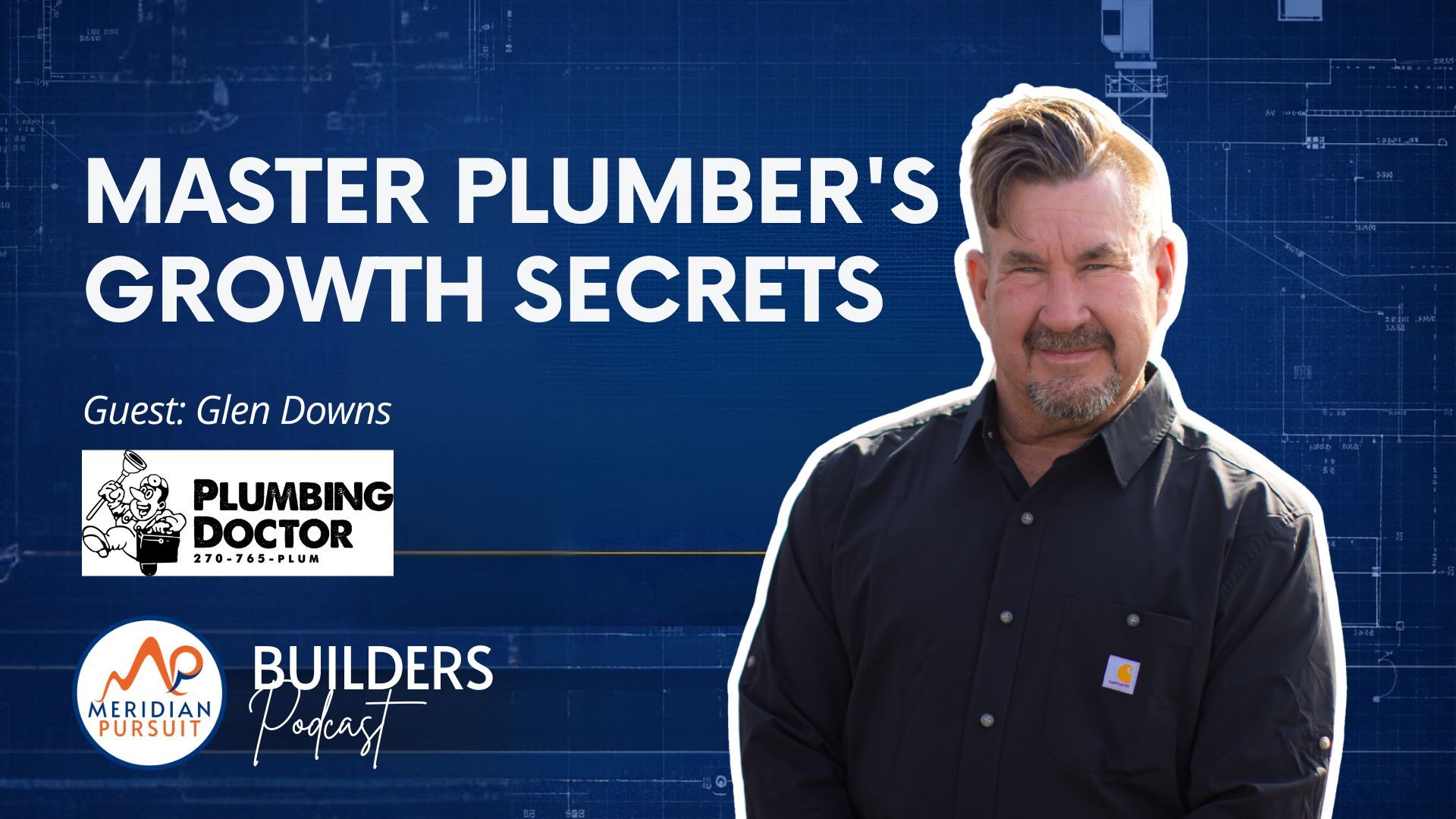
Learn how Glen Downs built Plumbing Doctor into a trusted local business in Elizabethtown, KY, through exceptional customer service and strong company culture.

Learn how Nick Riley acquired a 20-year-old roofing company and uses community involvement, education, and reputation to drive sustainable business growth.

Learn how custom home builders can compete with big box builders, improve communication, use social media to sell more homes, and build lasting trust in this expert guide.
